Friday, March 7, 2014

The Baroda March 2014, A A Raiba Felicitated and more..

NEWS


AA Raiba honoured with State Award


(Artist Abdul Aziz Raiba)
The Fine Arts Department of the State of Maharashtra honoured the painter Abdul Aziz Raba with a Lifetime Achievement Award towards his immense contribution to the field of Art. The event was held at Jehangir Art Gallery, and the Chief Guest, Honorable Minister Rajesh Tope presented the award on behalf of the state to the senior artist.

Also accompanying the event was The Maharashtra State Art Exhibition 2013-14 which previewed on the 5th March and will be on view till 11th March 2014 at the AC-3 gallery.

The show is jointly curated by Prof. Shashikant Kakade and Prof Anant Nikam of JJ School of Art and Zasha Colah and Sumesh Sharma of Clark House Initiative.

Traces and Tears
( Work on display)
Project 88, Mumbai presents a solo show of artist Sandeep Mukherjee, titled, ‘Traces and Tears’. Working in painting, drawing and installation, Mukherjee positions his work in abstraction that is both phenomenological and ontological - where aesthetics informs experience and art researches its own specific conditions. Improvisational and process based, Mukherjee's work investigates materiality and the body as a means to resist identity and conceptual determination. The work asserts pleasure and embodied criticality in order to inhabit an expanded field of structural logic and subjectivity. Following multiple paths through figuration, the performing body, architecture as site and abstraction, the work continues to explore the tension between process, image, affect and meaning. 

Mukherjee received an MFA from UCLA, and a BFA from Otis College of Art and Design, Los Angeles. Born in Pune, India, he lives and works in Los Angeles and is a Professor of Art at Pomona College. 


The show commences on 13th March and will be on view till 19th April 2014.

The Baroda March 2014
(Work on display)
Rukshaan Art presents a show at the Coomaraswamy Hall of the Chhatrapati Shivaji Maharaj Vastu Sangrahalaya, Mumbai, titled, ‘The Baroda March 2014’. The show will display paintings and sculptures made by upcoming as well as established artists.

This is an annual event, a brain child of gallerist and curator Rukshaan Krishna, where she involves and displays the works of the newer and the older generation of Baroda based or Baroda educated artists. The show aims to bring out the freshness and novelty of thoughts and skill of the artists.

The show previews on 8th March at 5:30pm and will be on view till 16th March 2014.

Fragment Nature
( Work by Maruthi Paila)
Icon Art Gallery, Hyderabad presents a solo show of art work by artist Maruthi Paila. The show titled, ‘Fragment Nature’ features abstract art works by the artist.
Abstract art is personal and subjective and Maruthi Paila explores those possibilities of expression in myriad ways. Moving away from figurative imagery, Maruthi dwells in the non-representational world. The acrylics and small format works are geometric, with criss-cross lines forming haphazard, asymmetrical patterns perhaps resulting from an outpour of the artist’s emotions. It’s like a mosaic of lines and colours. Yet, there is a sense of harmony in the composition. Maruthi has been seeking to find a language of his own working and exploring different types of imagery, figurative and non-figurative - a continuous exercise to develop his visual vocabulary for growth and perfection. 

The show previews on 7th March at 6:30pm and will be on view till 20th March 2014.

(News reports by Sushma Sabnis)


FEATURE


Bridging the distance
As an exhibition of astrophotography goes on in the city, Ajay Talwar, a participant and one of the few belonging to the tribe, explains why he loves to demystify the celestial world.
(SKY IS THE LIMIT: Dolly and Pankaj)
Demystifying the skies and bringing the celestial bodies closer to people are three photographers — Laurent Laveder, Thierry Legault from France and Ajay Talwar — at Jantar Mantar. The site, an 18th century astronomical observatory, couldn’t have been more appropriate, even though in recent years it has come to be first registered as a site of protest in our minds. But the exhibition “Astrophotography” — organised by Institut Francais en Inde, the French Embassy in India and the Alliance Francaise as part of “Fete De La Photo 2014 — A Photo Festival in Public Space” — in which science meets art, sits in perfect harmony with the space. Ajay Talwar, one of the few astrophotographers in India, talks about practicing this niche genre.
On astrophotography in India
Its popularity is growing at a good pace because of digital SLR. There are about 200-300 practitioners of it because digital SLR allows long exposures and full control over apertures. You have to expose your photograph for the right time to create star trails and that’s how you get an image. When I started 27 years ago, we used to shoot on film and we would come to know of our mistakes only later and it would take long to correct it. Amateur Astronomer Association of Nehru Planetarium (Talwar is its vice-president) has also popularised the genre. Members discuss different aspects of astronomy there.
On the technique
(Temple Moon Full Rise)
While in the daytime everything is done by the camera itself, when you are shooting at night, the photographer has to do a lot of things. The focus, the framing and the exposure, you have to decide everything. To do something like star trails, you have to keep shooting long exposure, say about 30 seconds through the night, but at Nanda Devi where the shoot lasted for three hours, I kept exposing for two minutes. It was a cold night and three cameras with timer remotes attached to them were placed at different locations. It is an interesting experience because the photographer spending the whole night beneath the sky can see it move.
Shooting night landscapes like I do doesn’t require telescope but yes when I do deep sky objects, I do work with telescopes. Otherwise I shoot on 35 mm lens, 50 mm lens or 200 mm lens in special cases like my image of moonrise above the Kalkaji temple. I was one-and-a-half kilometres away from the temple in a house in Sant Nagar. I had to plan the shoot in advance because I had to calculate the day and the time of such an alignment between the moon and the temple.
On bringing the human element into his photographs
The structures, temples and human presence entered my frame after I was invited by TWAN (The World at Night), a platform for photographers who shoot earth and sky in the night. I realised that to get people to relate to this world, it is important to have a relatable presence. Viewers are very receptive to such images. In the “Dolly and Pankaj” image which has become very popular, it is just my friend sitting under the sky at Hatu Peak in Narkanda, Himachal Pradesh, against the moving stars captured through exposures. I would tell my friend to stay still for five minutes, then ten minutes and then fifteen minutes in such biting cold.
Future projects
India’s largest optical telescope is coming up at Devasthal in Nainital and I have been documenting its creation. So I plan on doing a time-lapse video on it.

(Report by Shailaja Tripathi for The Hindu)

Thursday, March 6, 2014

Indian Divine, Head Tale, and more..

NEWS

Head Tale
( work on display)
Triveni Kala Sangam, New Delhi presents a solo show of paintings by artist Soumen Bhowmick. The show titled, ‘Head Tale’ tells the tale of hope, despair, failure, struggle, deceit and tears of all kinds of disillusioned people who make up the fabric of society. Like the children who perform on streets for a living, migrant labourers in an urban space who live with flse hope of ever becoming rich.  All these heads are reflecting the soul of our present society. The contemporary dilemmas of mankind are vividly portrayed here.

'Head Tale' stands on an understanding of daily exploration of a soulless journey towards attaining the truth. The show tries to visually trace the imperfect frameworks for negotiating the complexity of existence.  The elements facilitate engagement at all levels of consciousness, being provocative in nature. 'Head Tale’ is based on the inner turmoil and its struggle with various elements. Influenced by forces of society, norms of survival, rules of coordinated etiquette, economic pitfalls, political lies, back stabbing idiots, race to success.

The show is on from 15th March to 25th March 2014.
Versicoloured Days of Mine


All India Fine Arts and Crafts Society (AIFACS), New Delhi presents a solo show of paintings by artist Archana Das. The show is titled, ‘Versicoloured Days of Mine’ and on display are the vibrant evocative paintings of the artist. Delving into figuration and a strong narrative for her works, the artist presents a series with distinct stories to tell.

The show is to be inaugurated by eminent art critic and poet, Keshav Malik, and will be presided over by Ram V Sutar eminent sculptor and President of AIFACS and Paramjeet Singh, eminent painter and Chairman of AIFACs, New Delhi.

The show previews on 10th March 2014 and is on view till 16th March 2014.


Indian Divine

Delhi Art Gallery, New Delhi presents its upcoming exhibition titled, ‘Indian Divine:  Gods & Goddesses in 20th Century Modern Art’. The show explores the worship, propitiated, cajoled and given a primal place in the lives of Indians from the earliest of times to today.

The works are dated across three centuries from 19th century to present day, earliest work dating from 1849 on saint Chaitanya in the Early Bengal style. The exhibition aims to build a historical perspective and chronology of Indian art through mainstream religions like Hinduism, Buddhism,Islam and Christianity. It includes paintings in the Western style of deities by artists like Raja Ravi Varma, MV Dhurandhar and paintings from the Kalighat style and the early Bengal styles. Other artists works in the show are Nandalal Bose, Bikash Bhattacharjee, Ganesh Pyne, MF Hussain, KK Hebbar,Rabin Mondal, PV Janakiram,Krishen Khanna, FN Souza, Madhvi Parekh, Kanwal Krishna, S Dhanpal and V Nageshkar, GR Santosh, Sohan Qadri, PT Reddy, Sunil Das among many others.

The show is on view from 15th March to 26th March 2014

(News reports by Sushma Sabnis)

FEATURE

New art space, Tarq, opens in Colaba

A 3,000-sq-ft gallery, Tarq, opened in Colaba with celebrated photographer Clare Arni’s Disappearing Professions of Urban India on display


(A Tinner in Delhi; copper can react with acidic foods causing toxins. In such workshops, pots are tinned on the inside. With the coming of stainless steel vessels, this profession is vanishing.)
While art lovers are spoilt for choice at Colaba and the neighbouring Kala Ghoda sub- precinct, there always seems to be room for more. It’s evident with the opening of Tarq, the latest gallery to open its shutters at Colaba. The new gallery spans 3,000-sq-ft and is spread across the ground and first floors. Tarq in Sanskrit stands for discussion, abstract reasoning, logic and cause. The contemporary art gallery is dedicated to enabling a conversation around art from a diverse range of contexts.

Gallery talk
(Dhobi Ghat in Bangalore; there are 40 permanent members. With the introduction of washing machines their work is getting less and less.)
Gallery director Hena Kapadia elaborates, “The idea of this gallery is to be open to conversation, and to be a space where artist, collector, critic and art enthusiasts can learn and grow together. The intention is to have a space where different voices can be heard, and a sense of context and history can be developed.”

She adds that they wish to encourage a constant dialogue between the viewer and the artist and work with newer artists and collectors. “A clear sense of the artist’s thought and an insight into his practice are essential in choosing works for me. The influence of the artist’s larger context on the art, and how that is effectively expressed in the work is also essential to an artwork,” elaborates Kapadia.


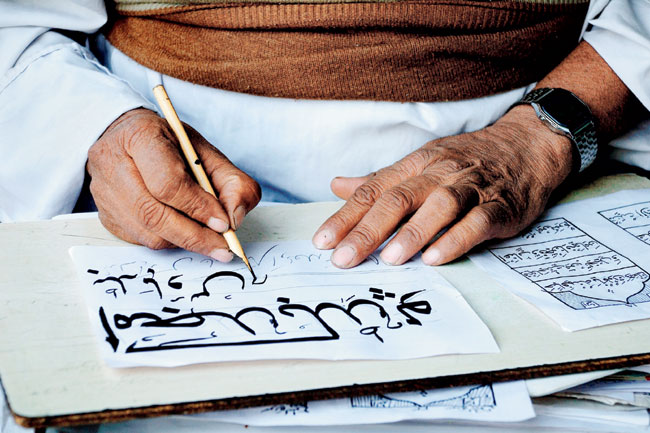
(Quri Mohd Yaqub in Delhi is a calligrapher. Arni recounts that he sat with his legs tucked under him and sang his answers to her questions.)
Offering some location trivia, she states that the gallery, located in Dhanraj Mahal, is one of Mumbai’s iconic Art Deco buildings. “It was built in the 1930s and was the former palace of the Raja Dhanrajgir of Hyderabad. It was designed by the architectural firm of Gregson, Batley and King, and is now home to several commercial enterprises as well as private residences. Having housed the British Navy in World War II, the building has recently been restored to its former glory,” she informs.

Bangalore to Mumbai
(Tarq gallery in Colaba is spread across 3,000-sq-feet)
The first exhibition to grace the gallery is Clare Arni’s collection of images featuring the country’s vanishing occupations. Kapadia met Arni in Bangalore and loved her photos and the thoughtful archive that she had created. The exhibition has 50 images on display. All are digital photographs, some are on paper and a few are printed on canvas.

The UK-born and Bangalore-based photographer says that she stumbled upon the subject of her latest exhibition, titled Disappearing Professions of Urban India: “I was working on the subject of urban change, and I found that this was a good way to document the changing face of the urban geography of India.” Arni, a professional photographer for over 25 years in India, shot these works over a span of six years. Till April 1st 2014.


( Report by Soma Das for Mid-Day)

Wednesday, March 5, 2014

A Million Smiles, The Journey of a Butterfly and more..

NEWS

A Million Smiles
( Work on display)
Ambience Mall, New Delhi presents a solo photography show of veteran photography artist Ashok P Kochhar. This would be India's largest solo photography exhibition by the eminent photographer. 
Titled, ‘A million smiles’ the show is a photography art initiative conceived by Kochhar to celebrate womanhood by exhibiting joyous smiles of more than 1000 women across Delhi - NCR. This exhibition displays a unique initiative, where experience and energy synthesizes at one place for a greater cause.

The show commences on Women’s Day, 8th March and will be on view till 16th March 2014.

The Journey of a Butterfly
( Work on display)
Goethe Zentrum, Hyderabad presents a solo show of paintings by artist Sravanthi Juluri. The show titled, ‘The Journey of a Butterfly’ is an ode to the bold and free spirited woman of today. The most scared place for Sravanthi is a plain white canvas waiting for her to express her feelings, raise her voice, and tell a story. She has always been fascinated by the human mind, and the way we react to different situations around us-pain and anger, happiness and joy. She loves to use her canvas as a story board and mostly as a tool to spread awareness about the crime committed against women and the trauma women undergo. She also likes to inspire women and young girls to look for inner strength and find the courage to stand up against the atrocities. 

The current works being showcased expose the inner thoughts and emotions of a woman, releasing her inner strength and letting go of inhibitions; feeling liberated. She explores the world in the form of a butterfly, sipping in the nectar of sweet victory. This is a show dedicated to all the women around who stood up against the odds and emerged as butterflies leading a new live.


The show is on view from 14th March to 24th March 2014.

A glimpse of an inner world
( Work on display)
Kamalnayan Bajaj Art Gallery, Mumbai presents a solo show by Shilpa Welkar. The works on display are figuratives and rendered in a realistic style. For the artist self –expression enables the inner-world to step into reality. So thought takes form and there is release and realisation. 
Environment, upbringing, experiences and inclinations imbue all art. This builds bridges and the greater good is accomplished. Here is a catalogue through time, of musings and tendernesses and the miracle of empathy. It is both an attempt at control and a need to surrender.

The show commences on 10th March and is on view till 15th March 2014.

A Myriad Woman
( work on display)
Malaka Spice Art space presents a unique show titled, " A Myriad Woman", a painting exhibition by upcoming artist Vishalini Paliwal. 

The show displays paintings which celebrate the essence of the feminine by focusing on the nuances and myriad expressions and emotions of the woman protagonist. The works take the viewer through an array of emotions. The show coincides with the Women’s day and portrays this feminine mystique.

The show is on till 15th March 2014.

(News Reports by Sushma Sabnis)

FEATURE


An ode to love
The canvases of The New Romantics are filled with the colours of love as it is experienced today
(RICH AND TEXTURED Basuki's canvas)
Kynkyny’s recent group exhibition on the occasion of Valentine’s Day titled “The New Romantics” showcased the artists’ perspective on the idea of romance, in their signature style.
The exhibition featured artworks in a range of media including acrylic, charcoal, pen and ink, tempera, collage, oil and mixed media.
Basuki Dasgupta’s landscape is a vivid red, signifying romance, with the figures — faces of a man and a woman, painted to appear as one. The canvas itself is rich and textured.
“The concept behind my painting is the relationship between a man and a woman. Two different units are coming together to show that they are one. I believe that when two souls come together with an emotional and logical understanding, something positive can come from it. That is romance,” explains Basuki.
“Life started when the elements of fire and water cam together. They are two extreme powers. But the appearance of love has changed though the form remains the same. I have shown this by making my canvas textured, to show that we live in a rough world today.”
G.Subramanian works with the medium of collage, creating images of the iconic Indian lovers, Radha and Krishna. Subramanian’s figures are rounded, their eyes are closed and they smile dreamily, appearing intoxicated by their togetherness.
“I like painting subjects from Indian tradition and I didn’t want to borrow from the tradition of the miniatures by painting Krishna and his gopis. I have always felt that Radha and Krishna make a nice pair. She’s older than him, she’s more mature and more caring,” says Subramanian, who believes that his work should spread joy.
“And my subjects have their eyes closed because I think it’s more romantic. When you have your eyes closed, your vision becomes infinite. And that’s what I wanted to express through the collage. I believe that it’s the love between a man and a woman that gives life to the earth.”
Sachin Jaltare fills his canvases with smoky, half-formed figures of a man and a woman in a delicate embrace. The only hint of colour, a vivid red, is on their foreheads. Their eyes too are closed, as if they are exist on another plane and their faces express an unfathomable depth
“I represent the Indian deities Shiva and Shakti, as body and energy, through my works. I have always been fascinated by the idea of Shiva Tattva or the supreme consciousness that represents the universe. As I started working I developed my own style of expression. The figures in my paintings are not completely clear, nor are they completely abstract,” he explains.
“And only when Shiva and Parvati, together as energies, can serve the purpose just as a bulb cannot be used without electricity.”
The exhibition also feature works by Basuki Dasgupta, Bakula Nayak, Dhrubajyoti Baral, Doddamani, G. Subramanian, Nishant Dange, Praveen Kumar, Subrata Das and Sachin Jaltare.
“The New Romantics” will be on view until March 8th 2014.
( Report by Harshini Vakkalanka for The Hindu)

Tuesday, March 4, 2014

A Celebration of Lines, Formative to Recent and more..

NEWS

A Celebration of Lines
(Work by artist Krishen Khanna)
Sakshi Art Gallery presents a solo show of renowned artist Krishen Khanna. The show titled, ‘A Celebration of Lines’ displays a range of the artists monochrome drawings and canvases. 

Krishen Khanna’s figurative and evocative works address the social, political and historical contexts through a strong portrayal of people and stories about them, for instance scenes of pre-partition India. Bringing out personal conenctions with the people portrayed, such as the Indian revolutionaries in his neighbourhood, Khanna  builds a picture not just as an illustration of a memory, but as a historical entity. The narratives are vast and deep, full of nuances, iconic and subtle all at once. The artist tries to evoke the emotive strength through his lines and pencil strokes effectively creating in the viewer and the work an interaction and an anchoring. The exhibition also will have a reproduction of the artist’s monumental mural, ‘Chola Migrations’. This mammoth work stands at 72.5 ft and depicts the rich life and cultural history of the Cholas of South and is regarded as one of the largest murals in pencil on paper.

The show previews on 6th March and is on view till 5th April 2014.

Daydreams

Five Forty Five Gallery, Bangalore presents a solo show of art works by artist Pradeep Kumar DM. The show is sponsored by the Department of Kannada and Culture. The show titled ‘Daydreams’ displays the vibrant and illustrative art works by the artist.

Pradeep is a Karnataka based artist and he graduated from the University College of Fine Arts, Davangere with a B.V.A Degree in painting. He also has an M.V.A Degree in Painting from Bangalore University.

The show is on view from 7th March to 4th April 2014.


Formative to Recent 
(Work by artist Jogen Chowdhury)
Cima Art Gallery, Kolkata is hosting the complete works of eminent artist Jogen Chowdhury. The exhibition is titled, ‘Formative to Recent’ and attempts to retrace the journey taken by the artist in his art practices and through different times and influences, which unfold in the range of art works.
On display are multi medium works, from paintings to film posters, drawings, etchings and lithographs, though having been displayed before in other venues, this show acts almost as a retrospective of the artists work.

The show is on till 29th March 2014.

Tangential Traverse

Aakriti Art Gallery, Kolkata presents a group show of artists, titled, ‘Tangential Traverse’. The show will display the paintings and sculptures of eminent contemporary artists along with yesteryear legendary artists works.

The participating artists are  Ajit Chakraborty, B.R.Panesar, Badhan Das, Bijon Chowdhury, Bikash Bhattacharjee, Dharamnarayan Dasgupta, Ganesh Pyne, Gobardhan Ash, Gopal Ghose, Indra Dugar, Jamini Roy, Meera Mukherjee, Nandalal Bose, Paritosh Sen, Sarbari Roychowdhury, Somnath Hore and Sudir Kastagir.

The show previews on 7th March 2014 and is n view till 31st March 2014.

(News reports by Sushma Sabnis)


FEATURE


The Renaissance Man: CSMVS Director Sabyasachi Mukherjee
(Director of Chhatrapati Shivaji Maharaj Vastu Sangrahalaya, Sabyasachi Mukherjee)
By now Sabyasachi Mukherjee is used to being asked if he’s the famous designer. After giving a talk at Sophia College some months ago, Mukherjee was accosted by two girls. “One girl asked, ‘You are the designer?’” Mukherjee says. “I said, ‘Do I look like a designer?’” Indeed Mukherjee, who is the director of the Chhatrapati Shivaji Maharaj Vastu Sangrahalaya (CSMVS, formerly known as the Prince of Wales Museum), could not look less like a fashion icon. With his crumpled sky blue shirt, bristly moustache and nerdy enchantment of antiquities – he endearingly pointed out his favourite stone Shiva gana in the museum’s sculpture section – Mukherjee is more professor material.
Mukherjee, 49, is too self-effacing to admit it but the CSMVS entered a renaissance soon after he became its director in 2007. Suddenly there seemed to be regular activity at the CSMVS most notably in the form of a string of shows brought from museums abroad such as the British Museum and the Victoria & Albert. Over the years, it has shown exhibits of Chinese terracotta warriors, and the mummy of Egyptian temple priest Nesperennub; made room for the Jehangir Nicholson Art Foundation, a gallery of contemporary Indian art; and hosted displays of Persian antiques and Flemish paintings. Before 2007, Mumbaikars could not have imagined a Rubens coming to the museum, which was widely regarded as a fusty place that school kids paid a mandatory visit chiefly to see the stuffed animals and forget thereafter. As Mukherjee puts it, “Nowhere was the enjoyment element visible”.
This state of affairs was tragic as the museum has a spectacular collection of over 60,000 artefacts with gems like the Anvar-i-Suhayli, a 16th century Persian translation of the Panchatantra; Akbar’s personal armour; and some gorgeous miniature paintings. “There was no concept of the modern museum,” he says. “No concept of curated shows, interpretation, educational programmes, the museum as a space for social debate. American, European and some Asian museums were way ahead of us. In the 1990s they were talking about the global museum. We remained in the early 20th century.” Then the wave of globalisation, which dramatically altered our economy and popular culture, finally swept the shores of high culture. “Now foreign museum directors are visiting Indian museums,” Mukherjee says. “But we’ve lost many years.”
As a young adult, Mukherjee never imagined he’d end up spearheading a major Indian museum; he grew up in Bolpur, a small town in West Bengal that’s known for its proximity to Shantiniketan (it’s what Shirdi is to the Sai Baba temple, Mukherjee says). Thanks to Shantiniketan’s Vishwa Bharati, the university Tagore founded, the atmosphere there carries the charge of a deep artistic tradition. Mukherjee grew up in a family of teachers to be a lover of poetry. But it was chance and some youthful vacillation that led him to a career in the arts. He intended to do a Master’s in social work at MS University in Baroda, an institution renowned for turning out some of the best artists in the country. But when a cousin studying there urged him to get a degree in an artistic field, Mukherjee did an MA in ancient Indian history and archaeology and a second one in museology.
While studying museology, Mukherjee worked as an intern at the CSMVS in 1989 under Sadashiv Gorakhshkar, who was director from 1975 to 1996. Mukherjee described Gorakhshkar as his greatest mentor. “He had the spark to continue to work for the Prince of Wales museum,” Gorakhshkhar said in a phone interview from Vasind, where he now lives. “It was an outgoing museum – we had a lot of extracurricular activities and I thought he fitted into the brief. While leaving, I told him never to leave. I said no other museum offers what the Prince of Wales does.” Mukherjee took his mentor’s advice. He joined as a research associate in 1990 and has been at the museum since then.
One of Mukherjee’s obvious talents is fund raising. The museum functions autonomously and while it does get some money from the central government, it’s largely supported by individual patrons and corporate companies. Their largesse has paid for the classy plaza near the entrance designed by Rahul Mehrotra, for restoration projects and foreign shows and new galleries. Mumbaikars can look forward to two new galleries this year – one showcasing the city’s textile history and the other a gallery of prints and drawings that gallerist Pheroza Godrej and writer Pauline Rohatgi are giving the museum on a long-term loan. “Money comes with great ideas,” Mukherjee says.
Perhaps the real beneficiaries of Mukherjee’s vision and that of his splendid colleagues are the city’s kids. It’s common to see groups of school children being shepherded around a show and briefed by the museum’s education officer Bilwa Kulkarni. Some of these kids are exposed to art for the first time – they include the offspring of sex workers, construction labourers and BMC sweepers and are taken to the museum on field trips organised by CSMVS and various NGOs. “Our approach is to enlighten those who are not enlightened,” Mukherjee says. “A museum brings changes to human life. You come to interact with your past to understand the present and the future.”

(Report by Pronoti Datta for Mumbai Boss)

Monday, March 3, 2014

OBITUARY - Prafulla Dahanukar (1934 - 2014) Of Immortality through Art..

OBITUARY 

Prafulla Dahanukar (1934-2014) - Of Immortality through Art

When one tries to retrace the footsteps of a senior artist who has passed away, one is left facing the hollow transition from the world of the ‘is’ substituted rapidly with the world of the ‘was’. Veteran artist, Prafulla Dahanukar was claimed by history on 1st of March 2014. The void she left behind in the art scene, is comparable only to the irreconcilable chasm felt between the ‘is’ and the ‘was’, observes Sushma Sabnis.

( Artist Prafulla Dahanukar)
‘Prafulla Tai’, as she was lovingly addressed by many who knew her, was renowned for her intense, meditative and soulful abstract paintings. Naturally beginning with the figurative language she moved towards portrayals of landscapes, eventually breaking away from all classifying agencies, to paint ‘Freedom’ in her works. Her attempt was to paint peace through her art works. Her works acted as windows which opened up to vast expanses of an internal ‘space’; a womb of the Universe, where everything co-existed in harmony. She believed this space and freedom reflected the quintessential human mind. Blending the microcosmic and the macrocosmic in a singular thread of her artistic journeys, exploring line, form, colour and texture in her works, Prafulla Tai unlocked windows within the viewer’s mind. Embedded in the paintings were depths of a tranquillity, an energy and a complex interplay between finite and the infinite, reflecting the indomitable spirit of the artist. 

Her keen interest in theatre and classical music also contributed to the essence of her works. The flow and ebb, the crescendo and the tiny flecks of distinct notes reflected in her art works. Her painting series titled, Ragas (1962) are examples of the union of the moods of music with her artistic expression. Her exploration of abstractions in nature had been an influence at an early age and this manifested in her large scale works. She is also well known for her murals in ceramic, wood, fiberglass and glass mediums, which adorn some of the prominent buildings in Mumbai, Kolkata and several other cities. She had a great interest in public art and would often be seen as a keen visitor of the Kala Ghoda Arts Festival held at Mumbai. Many of her paintings are in private and public collections in India and all over the world and have been part of several auctions conducted by auction houses like Sotheby’s and Osean.
(Work by Prafulla Dahanukar)
Her friendly nature and charm helped her build an easy rapport with people of all ages, and the support she offered to the younger generations of artists is well known. One cannot forget her reminisce and narrate anecdotes and interactions with renowned artist  MF Hussain who she admired and who she dedicated her poem to during his memorial service held at Jehangir Art Gallery in 2011. Prafulla Tai was also known for being a part of the art movement in India along with several well known founder members of the movement.  She set up her studio in Lonavala where her humanitarian side came into focus when she was involved as the main trustee of an orphanage called Bal Anandgram for thirty years.

Born in Goa, Prafulla Tai was a J J School of Art, Mumbai (1955) graduate. She was later granted a year long scholarship to pursue her studies at the Echole de Beaux Arts and Atelier 17, Paris(1961). She had been having shows of her works since 1956, and won a silver medal at the Bombay Art Society Portrait Exhibition, later on becoming the President of the Society from 1993-1998. Apart from this she had been on the committee of Jehangir Art Gallery, Lalit Kala Akademi, Goa, and also was the President of The Art Society of India and the Chairperson of the Artists' Centre, Mumbai.


(Prafulla Dahanukar at the Neerja Modi Art Camp in 2009)
When one visits the web site of this impactful artist who dedicated her life to art, one is overwhelmed by her accomplishments in the eighty years of her fruitful life. She was someone whose art career spanned over 50 years, not just as a prolific artist but also as a patron of the arts, a guide to upcoming artists and an inspiring human being. One would often find her in the galleries visiting the art shows, interacting with the artists and students, sharing valuable experiences of her art practices with them.

There is a certain unavoidable grief felt at the loss of an individual who has touched and influenced so many lives in a good way, but it would be pessimistic to say that an artist is dead. Artists can never die, because they live on through their works, their art becomes a living entity for all to become part of. In that sense each time a viewer connects with her art, Prafulla Dahanukar would come alive in the minds and hearts of the viewers, making her immortal.

Prafulla Dahanukar lives on in the memories of her husband, Dilip Dahanukar, and daughters, Gopika and Gauri and the entire art fraternity.


(All images have been acquired from the internet for illustrative purposes only)


NEWS

Chasing Mirrors
( Work on display)
Apparao Galleries, Delhi presents a group show of artists titled, ‘Chasing Mirrors -  A reflection and exploration of urban geographies’. With a focus singularly on the cities that we live in today, which are in a state of change constantly. The show addresses the coexistence of chaos and tranquillity, modernity and tradition, the materialistic and the spiritual, all popping up at every twist and turn in a city street. This colourful deterministic and indeterministic chaos is reflected in the cityscape, defining and redefining the geography of the urban space in an ever changing dynamic state of existence. This has acted as an inspirational elixir for the artists who have tried to portray it in their art works.

The participating artists are, Alexis Kersey, Dhasan, Kumar Ranjan, Mainaz Bano, Mukta Wadhwa, R M Palaniappan, Rajeev Kumar, N Ramachandran, Rohini Singh, Suchit Saini, Vidhan Kumar and Vinita Dasgupta.

The show is on view till 30th April 2014 at The Lodhi, New Delhi.

Mood
( Work by Ribaka Nikam)
Gallery Pradarshak, Mumbai presents a solo show of art works by artist Ribaka Nikam. The show is titled, ‘ Mood’ and on display are works by the artist rendered in acrylic on canvas. 

Ribaka is a painter, sculptor and a ceramist who uses all the elements to aptly portray her thoughts in art.The works are primarily figurative with narrative quality distinct to her style. Using bright hues and vibrant colours she anoints the works with a certain amount of positivity and movement. Using the child Buddha as a muse, she depicts the visages of her the muse in multiple representations. Introducing at times decorative elements and layering the visages with a narrative element, the works are replete with textural nuances made with calligraphy and other skills, uplifting the paintings.

The show is on view till 14th March 2014.

Women With Substance


Prakrit Art Gallery, Chennai is celebrating International Women’s day by commemorating Women artists from all over India and showcasing their works. A unique show will be held at the gallery, which will feature works of these women artists who have faced struggle and challenges in life to get to a respectable stage in life.

The participating artists are, Asma Menon, Arpana Kaur, Bandana Kumari, Gita, Hemlatha, Kamla Ravikumar, Mariam Castelli, Razia Tony, Rini Dhumal, Seema Kohli, Seema Ghurayya, Shipra Bhattacharya, Thejo Maye Menon.

A percentage from the sale of paintings will be donated to CanKids by these women artists and Prakrit Arts who wants to sensitize people about working for noble causes through their art.

The show commences on 10th March and is on view till 15th March 2014.


(News reports by Sushma Sabnis)

Saturday, March 1, 2014

Subraan, Tracing Layers, Emerging Lines and more..

NEWS

Wo/Man: From the Personal to the Political


( Work on display)
Sir J J School of Art presents an exhibition which looks at the deeper cultural roots of the construction of gender identities and of the relationship between men and women in urban India today. Eight young artists Salik Ansari, Shruti Bhosle, Makarand Dhotre, Yogesh Kamble, Lini Radhakrishnan, Aditya Rajput, Jinal Sangoi and Kruttika Sequeira have come together to showcase their work in the show titled, ‘Wo/Man: From the personal to the political’.
The exhibition looks for connections between the ideas of gender and safety, exclusion and inclusion, protection and segregation. The show plans to use various mediums like sculpture, painting, print, photography, video and performance to explore several ideas of gender.

This exhibition attempts to create a socio-political dialogue not only within the artistic environment the young artists work in but also the city they live in. By analysing the ways of categorising, constructing and representing gender, the artists suggest alternate gender identities through a critique of the framework of our normative gender binary.    
The show is on view till 14th March 2014.

Subraan
( work by Ramesh Gurav)
Jehangir Art Gallery, Mumbai presents the exquisite figurative works of eminent artist Raosaheb Gurav. The show is titled, ‘Subraan’ and will display the vibrant and colourful works of the artist. Raosaheb’s works usually feature the rural and village life, with special focus on the village folk and various communities, from places like Kolhapur and Pune. The ar work in this particular exhibition focuses on the ‘Dhanngar’ community, who rear cattle. The works portray landscapes, rural lives and farmlands with the protagonists at their everyday jobs as goat and cow herds. The works are rendered in various mediums like water colours, oils, acrylics pen and inks.

The show is on view till 4th March 2014.

Emerging Lines
( work on display)
Mahua Art Gallery, Bangalore presents a show titled, ‘Emerging Lines’, a new series of works by artist Shirley Mathew who expresses her perceptions of a growing city, through her paintings. Using colours to portray the seasons interspersed with geometrical forms, suggests the viewer to go through a journey and make their own impression of the representational icons used to convey the message.    

Her observations during a recent journey through Italy making note of the aesthetics of humanity merging at times with what she believes is uncompromising terrain, was truly inspiring enough to do a series to paintings. Shirley has great interest in organizing annual art awareness shows, to connect with people and to create an environment for an informal viewing of art in her studio courtyard.   

The show is on till 8th March 2014.

Tracing Layers

Ananya Drishya and Venkatappa Art Gallery, Bangalore present a solo show of art works by the artist Ramesh Kalkur. The show is titled, ‘Tracing Layers’. Ramesh completed Diploma in painting at Ken School of Art, Bangalore 1990, Post Diploma in Painting at Faculty of Fine Arts, M.S. University, Baroda 1993 and M A in Painting at Royal College of Art, London, 1996. Held several solo exhibitions including  'Assemblages' at Pundole Art Gallery, Mumbai 1994, Traveling show of photographs, Sakshi Art Gallery, Bangalore, British Council Gallery, Chennai, Chitram Art Gallery, Cochin 1998, ”11 X 11” at Sumukha Art Gallery among several others.

He received the Inlaks grant for artist in residence at Kanoria Centre for Arts, Ahmedabad, 1991, Inlaks Foundation Scholarship and Overseas Development Association shared scholarship scheme to study at Royal College of Art, 1994 – 96, John Minton Travel Grant for three months exchange program to study at Art college in Berlin.

The show commences on 8th March 2014.

(News reports by Sushma Sabnis)


FEATURE
New contexts of tradition
The exhibition 2D3D by Gallery-g at the Taj West End showcases traditional ideas in a Western aesthetic
(Normalising the gods)
The East and West come together, in the exhibition of ‘fusion art’ titled ‘2D3D’ presented by Gallery-g at the Taj West End.
The exhibition features three artists — Priti Singh, Kandi Narasimalu and Sri Lanka-based Leo Pasquale. The three artists deal with a range of subjects that span across timelines in human history, from the ancient/mythological, the old and the modern.
Priti Singh expresses her love for Indian mythology through her series of paintings depicting Indian Gods and Goddesses in a rather contemporary context. The Gods and Goddesses, in all their finery are seen performing every task, Shiva lounges on the sofa with a drink while the Devi, seated above on a carpet is adorning herself with lipstick and nail polish. In another instance, he is seen doing his tandav with an electric guitar (complete with an amplifier in the background).
Priti also depicts a divine family scene where Shiva and his consort are bathing Ganesha. Shiva pours water while the Devi scrubs him. Karthikeya meanwhile is bathing himself in a blue bathtub. “I have always been fascinated by Indian mythology because I belong to Benares and my family used to spend a lot of time visiting temples. So this always reflects in my paintings,” says Priti. “But I don’t think God only slays demons and helps us solve our problems from somewhere above. I think Gods also lead normal lives like us,” says Priti.
Priti’s Gods are painted in vivid fluorescent shades set against light backgrounds. She draws her inspiration from the walls of Ujjain, Benares and rural Rajasthan, where the figures are often painted in these shades. Priti says she also draws her imagery from the tradition of the Gonds, among whom she has spent time working.
Kandi Narasimalu meanwhile is preoccupied with the life and the people of rural Andhra. His canvases are filled with tall, strong frames of the women and men on Andhra’s heartlands. The women are dark-skinned, with lean figures and curvy bosoms. They wear shiny golden jewellery, which the artist draws attention to through his embellishments. Their attire is vibrant, contrasting with their dark skin.
The women are seen gossiping, dressing themselves in front of the mirror with a comb tucked in the folds of their saris and carrying their wares over their heads.
“In my paintings I usually depict my family and their lifestyle in the village and so my works have a distinct rural aesthetic. The traditional culture in the villages is fast disappearing; so many aspects of our heritage are disappearing. So I have tried to draw attention to some of these tangible aspects of our heritage,” says Narasimalu, whose imagery is deeply inspired by his work in the field of 2D animation, in its minimalism of line and form.
The exhibition also features works by Leo Pasquale. ‘2D3D’ will be on view at the Taj West End, Race Course Road, until March 3rd 2014.

(Report by Harshini Vakkalanka for The Hindu)